Sunday, May 15, 2011

Tsunami Fundraiser, Part 2

Last week's fundraising event for Japan was another success. It a yard sale, along with food stalls selling a variety of items.

We woke early and made a number of dishes for the bentos we sold. It was a labor-intensive three hours, making me feel empathy for the chefs and kitchen staff everywhere who do such work everyday. The work also reminded me of the bento factory at the heart of the novel "Out", by Kirino Natsuo.

Dozens of eggs to make dozens of portions of tamago yaki.

Tiny sausages cut just right turn into little octopi.
The factory at work.

50 bentos in all.

Completed and sealed for sale.


The yard sale was indoors, essential with the daytime temperatures reaching the mid-30s (90s F) and 90% humidity. Our bentos surely would have gone bad in the heat.

H selling bentos, and helping another person make somen.

Japanese Studies students selling drinks.

Posters with information about the earthquake and tsunami.
All told, the event helped raise nearly $10,000 to children orphaned by the disaster.

Friday, May 6, 2011

Tsunami fundraiser

I am proud to be part of another fundraiser for the tsunami victims. This time the focus is on children orphaned by the disaster, and the charity is Save the Children.

We will make some food to sell. Wait...who am I kidding? H will make food to sell, and I will clean up after her and enjoy taste-testing items.

According to media reports in Japan, people are cleaning up areas and rebuilding more quickly than I imagined. But some recovery will take longer than others, or will be impossible, especially recovery of whole families. Let's hope we raise vast sums for these children so that they can begin to recover some sense of normalcy.

Monday, May 2, 2011

Seattle

Several weeks ago we took a short trip to Seattle. The last time we were there was May 2004. I was attending a conference this time around, and H was able to take a few days off work to enjoy the city and visit a friend.

As chance would have it, we both have high school friends who live near Seattle. So, after arriving we split to visit our respective friends for two nights. Then we met back on the third night in Seattle to stay the final night together before my conference began and H returned home.

I went to Bellingham, which I would describe as a sleepy university town - if that is not too much of a contradiction. Most homes are modest, and the tallest building might be 6 or 8 stories tall. I stayed in my friend's beautifully-renovated duplex and enjoyed adjusting to jet lag via long walks in the drizzle, good local beers, and extended reminisces with him and his partner.

Such a cool house - garden in front, baby chicks in the garage, compost in back.


Walking the dog before saying farewell.

Back in Seattle, H and I went to the Public Market and walked around in the sunshine. It was a great break from the heat, humidity, and routine of life in Singapore.

Tulips at the Public Market.


I was so happy to need to wear a warm hat!

Sushi demonstration

Last weekend we invited friends over to make sushi. They are Singaporeans we have been fortunate to become acquainted with simply due to geography. They own the apartment next to ours, although they don't live there full-time. They invited us to their home a few months ago, so we finally returned the favor.

They have traveled to Japan numerous times and have always loved the food. So H and I decided to serve them a variety of homemade dishes and teach them to make some simple rolls.


Of course, H did all of the cooking, while I cleaned the house and kept everything in the kitchen clean so that she would not be slowed down.


One highlight was the tempura, something most people associate with Japanese cuisine, but which we don't usually prepare at home. Tempura is something best left to professionals, who know the precise thickness of the ingredients, temperature and type of oil, and amount of batter to apply to make the perfect blend of warm crunchiness outside and soft vegetable inside that retains its natural flavor. H made asparagus, sweet potato, eggplant and shimeji mushrooms.

Edamame (right) and a potato salad with parsley and tomatoes.

Watching the sushi roll demonstration.
Three of our friends tried to make a roll (the son declined). We used fresh New Zealand salmon as the main ingredient, along with cucumber, fried egg, salmon roe, and other items.

One of the most exciting parts of the visit was their joy in seeing our huge world map on the wall. We purchased this when H was learning the airport codes for her job. Both the parents and the two kids (aged 15 and 17, I think) stood in front of the map pointing out places they'd been and places they wanted to go. That is the wonder of a map!

Another great discovery of the visit was their interest in board games. We spotted them playing Scrabble last week, and I hope to join them sometime. Knowing their interest in games, I pulled out Settlers of Catan and Carcasonne, and they were hooked. We haven't had have time to play yet, but I hope to establish a regular game night soon!

Hiatus

Apologies for my lack of recent blogs. After all of the news surrounding the disaster in Japan, it has been difficult to return to writing about more everyday items.

However, I am going to return to semi-regular posts of our life in Singapore. Since I'm writing this blog partly for my own long-term memories (in lieu of photo albums and diaries), I want to keep it up or I'll forget so much of what has been happening.

c

Thursday, March 24, 2011

Raising funds for Japan

The NUS community continually surprises me and makes me very proud to be here. Last week was one of those moments.

One day following Japan's devastating earthquake and tsunami, the students in Department of Japanese Studies took it upon themselves to organize a fund raiser for the Red Cross to assist the victims. Many of these students have been personally moved by Japanese culture since they were very young. Most of them have also been to Japan, either with their families or on study abroad. Japan has continually impacted these students, not only on an educational level, but personally as well. This was an opportunity for them to give back to the country that means so much to them.

Planning began immediately, with the students emailing and calling one another, establishing different committees, and gaining permission from the appropriate University authorities. The effort was called "Send Love to Japan" (see poster below). Over two days, students carried three boxes around campus and collected donations from anyone willing to contribute. A fourth box was placed in front of the Central Library, where passersby had the opportunity to fold one or more paper cranes in a symbolic gesture of hope for the disaster victims.


The students hoped to raise S$10,000 (about US$8000), which I thought would be difficult, but possible. How many students would give money to help the Japanese? How strong would the memories of Japan's military presence in Singapore be? Would Singaporeans be willing to send money to a country with a much larger GDP than its own?

Near the end of the first day I decided to stay and help count the first day's donations. For two hours I assisted six students and two other staff in counting every coin, note and check dropped in the four boxes. We were shocked to find that the students collected just over $26,000 in one day!!
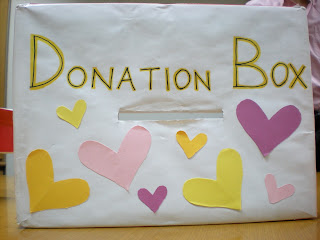
Top of one of the donation boxes.
Having already exceed the goal, I thought that most students and staff had given on the first day and that the next day would have a smaller total. However, the next day's total was $34,000, making a two-day total of $60,000 (US$47,500)! Sadly, I later learned that this is more in relief than the Singapore government sent Haiti last year following its own terrible earthquake.

After two days of raising funds, the students and two of us faculty took the money to the Japanese Association here in Singapore (which then gave the money to the Red Cross). We brought the money in the original boxes, and gave a string of one thousand cranes, too.
Students giving donations to Japanese Association representative
Happy students after turning over the donations

Cranes made by hundreds of individuals now hang in the Japanese Association as a reminder of the efforts of our students and the entire NUS community.

Cranes hanging in the lobby of the Japanese Association
In the end, the students wanted no credit for their efforts. They did not notify newspapers and television and avoided these people when they eventually learned of the efforts. Instead, the students referred reporters to the Department Head. In the end, they credited the students, staff and faculty of NUS for stepping up and showing their concern about the Japanese people in their time of need.

Monday, March 14, 2011

Sea walls and tsunamis

In my last post I wondered when criticism would begin of Japan's expensive and mostly ineffective sea walls.

Sunday, two days following the devastating earthquake and tsunami, NHK was already talking about the inability of sea walls to stop the massive energy of the 9.0 quake. NHK interviewed Japanese scholars from Tokyo University, who questioned such walls, and showed a short segment on Tarō-cho (田老町), Iwate Prefecture (see this short Wiki link), which suffered tsunami damage in 1896 (or 1898*) and 1933 and subsequently built a 10 meter (30 feet) high wall to try to protect itself. I placed a dot on the town in a Google map to indicate the location of the town. I placed the dot on the point where two sea walls converge to form an X, then stretching in four directions. You can zoom out of this map and see the town's location within Japan. You can see the sea walls clearly, although they should be more visible in Google Earth, because you can tilt the view and approach the town from the sea.

The New York Times also has a story about Japan's reliance on sea walls and their ineffectiveness in this recent disaster. The article describes the complacency that can arise when people put too much faith in a man-made structure that cuts them off from a potentially deadly force. If people cannot see the ocean, they cannot watch for small changes that might indicate something dangerous heading their way.

Short post today. I must run to school and try to teach something today about this horrible tragedy.

*I thought I heard NHK say it was the 31st year of Meiji, which would be 1898. However, the Wiki link says the earlier disaster was in 1896.